Wednesday, May 21, 2008

NEA Design Director here to explain it all for you Today

A last minute reminder that Maurice Cox, Design Director for the National Endowment for The Arts, will be at the Chicago Architecture Foundation today between 3:00 and 4:30 P.M. to meet with Chicago's design community and present and answer questions about the NEA's resource and funding structure. If you are interested in attending, please reserve your space by calling Larren Austin at 312/922.3432 x 245, or via email at laustin@architecture.org.

Tuesday, May 20, 2008

Bob and Denise Sneak Peek at Pecha Kucha V

Celebrating its first birthday, Pecha Kucha Night Chicago, the unique forum that gives designers, foodies and other creative types of that ilk 20 images, 20 seconds each, with which to make a presentation in the relaxed informal setting of Martyr's on north Lincoln, will have as its June 4th opening act a 13 minute preview of Learning From Bob & Denise, an in-the-works documentary profiling architects Robert Venturi and Denise Scott Brown, the soft spoken but dynamo team whose work and writings - Learning From Las Vegas, and Complexity and Contradiction in Architecture - redefined architecture itself in the closing decades of the last century. The documentary's all-star supporting cast includes Frank Gehry, Rem Koolhaas, Ada Louise Huxtable, Paul Goldberger, Peter Eisenman, Tom Wolfe and Cher. Producer/director James Venturi (probable relation) will discuss the project, now in its fifth and final year of production.

After that, it's back to form with an evening of fast moving presentations that will feature architect Michael Wilkinson, AIA/Chicago's Zurich Esposito, Redmoon Theatre's Jim Lasko, Ed Stevenson, Arielle Weininger of the Spertus Museum, Monte, Abby Factor, Jeffy Scurry, mountaineer Arild Øvrum, Joshua Wentz, Steve Skinner and, as always, Cher.
Pecha Kucha IV in March, despite my presence as a presenter (that's me in the middle of the photo set above, scaring the small children), sold out, and there's no reason not to expect V will, as well. Wednesday, June 4th at Martyr's, 3855 North Lincoln. A "special opening act" is scheduled for 7:45 P.M., with the main program from 8 P.M. to 11:00 P.M. Tickets, $10,00, can be purchased here. Food and drink (pizza!) available for a modest increment.

Acetylene Torches - Menace to Classic Architecture?

Around 2 P.M. on Tuesday, a major fire broke out on the roof of Berlin's landmark Philharmonie concert hall. Berlin Philharmonic musicians hurriedly broke into lockers and removed their often priceless instruments to safety. A final assessment of the damage is still to be determined, but it will be, without doubt, substantial. The Guardian reports that sparks from welders' torches set insulation materials ablaze. The only good news in all this is learning that Claudio Abbado is back. The fire broke out as he rehearsing the orchestra for a series of performances of Berlioz's Te Deum this coming weekend, now in a venue to be named later.

In 2006, welding torches figured in the destruction of two of Chicago's dwindling list of Adler & Sullivan landmarks. First, Bronzeville's 1891 K.A.M./Pilgrim Baptist Church was burned to its bare walls in January of that year, in a fire reported to have been caused by welders working to repair the roof. Only months later, the 1887 Wirt Dexter was destroyed by a fire begun by welders dismantling a boiler in the structure's basement. (The cause of a suspicious blaze in November of 2006 that wiped off the map still another Adler and Sullivan work, the 1888 George M. Harvey house, has yet to be disclosed.)

I'm not sure what the answer is to all this, but I'm pretty sure "Accidents happen" isn't it. Shouldn't there be tougher oversight on the use of welding torches in protected landmark buildings?

Beauty and the Beasts on Boul Mich

A shy groom, a radiant bride. A recent Saturday found us capturing these pictures of a wedding party taking pictures in the middle of Michigan Avenue just north of the bridge.


Meanwhile, just across the street, J. Seward Johnson's towering cupronickel King Lear statue, managing to look vaguely Christ and alien-like at the same time, is now doing some big time brooding in Pioneer Court. Is it just me, or is John Kearney's anatomically correct, automobile bumper Moose looking none too happy fitted with Cordelia's mantle and having his former privileged position on the plaza so rudely usurped?

Sunday, May 18, 2008

No Some Time for You (but later)

We were all ready to bemoan the fact that the striking exhibition of the work of Olafur Eliasson, Take Your Time, had time for everywhere but Chicago, making stops at both SFMoma, and, currently, at New York MOMA's P.S.1 outpost in Queens, where it runs through June 30th.

A recent Chicago Tribune interview with new Museum of Contemporary Art Director Madeleine Grynsztejn , however, revealed that the Eliasson show will, in fact, be making a Chicago stop at MCA, sometime next spring. Using light, color, water, ice, moss and mirrors (no smoke, as best as I can tell), Eliasson creates indoor environments that are, by most descriptions, both disorientating and hypnotic. I'll looking forward to seeing how his rooms bend and define our concepts of space.

This summer, from mid June through mid October, Eliasson's The New York City Waterfalls will cycle water from the East River and cascade it down from heights up to 120 feet at locations along both the Brooklyn and Manhattan Bridges No fish will be harmed in this project, we are promised, and the electricity required to run the thing and power the LED's that will light up the wateralls after dark will all be generated from renewable resources. Circle Line boat tours will let people get a close-up view, provision of rain gear still be determined.

A Walk Through Time - Prairie Avenue, from the Inside

On Sunday, June 8th, from 1:00 to 4:00 P.M., the Glessner House Museum will hold its annual benefit, A Walk Through Time, offering a Prairie Avenue tour that will include a rare look at the interiors of five privately-owned mansions, including the Harriet Rees , Elbridge G. Keith, William H. Reid, Charles W. Purdy and William Kimball homes, as well as the historic Second Presbyterian Church and the Glessner House itself. The tour will be followed by a silent auction, and a viewing of a new exhibition, Chicago's Historic Prairie Avenue, based on the newly published book of the same name. Tickets are $50.00 ($40.00 for Glessner House Museum members), and will be available at the door.

On Friday, June 6th at 7:00 P.M., author William H. Tyre will be at Glessner House to sign copies of Chicago's Historic Prairie Avenue, and talk about some of the stories he uncovered during his research. The event is $25.00 ($20.00 for museum members), with all proceeds going directly to support the museum.

RSVP's for both events can be made at 312/326.1480. Information on-line.

Friday, May 16, 2008

News Flash: Plan Commission Approves Children's Museum Land Grab

Thursday, May 15, 2008

Casting Piano's Nichols Across the Road

As a serial seducer lurks nearby, Renzo Piano's Nichols Bridgeway, which will join the Art Institute of Chicago to Millennium Park, crosses a major hurdle. See all the pictures here.

Preservation Chicago's New President Not Fine

On May 6th, the grass roots activists group Preservation Chicago became a bit more rooted when it named Bill Neuendorf, 40, an engineer whose work includes the preservation of historic structures, as their new President. Neuendorf takes over from long-time president Jonathan Fine, who co-founded the organization with ongoing VP Mike Moran in 2001, with Fine now assuming the title of Executive Director. The final sentence of the press release gave us a bit of pause. "Previously an all-volunteer organization, this new leadership team is ready to propel Preservation Chicago into the next chapter of its professional life." As reported by Blair Kamin, PC will now have paid staff, including both Fine and new Communications Manager Stacey Pfingsten, both in part-time positions (at least in salary), thanks to grants from the Driehaus and Alphawood Foundations. This makes PC more "organization", but it's also liable to make the importance of fund-raising, now required to make the payroll, more central, a step that can prove treacherous. Here's hoping PC's donor base has grown to the point of sustaining their new ambitions over the longer term.

Wednesday, May 14, 2008

Six Reasons Why the Chicago Children's Museum doesn't belong at Daley Bicentennial Plaza in Grant Park

No pictures, pretty or otherwise. You can find a lot of those elsewhere.

As the Chicago Plan Commission's consideration of the Chicago Children's Museum proposed move to Grant Park grows near, we offer an extended summary argument on why putting it there would be a very bad thing. Read it all here.

An alternative view: In Support of the Chicago Children's Museum in Grant Park


From our vigorous blog correspondent Jack. Read his critique and see all the pictures here.

Monday, May 12, 2008

Chicago Children's Museum - Spaghetti Bowl East?

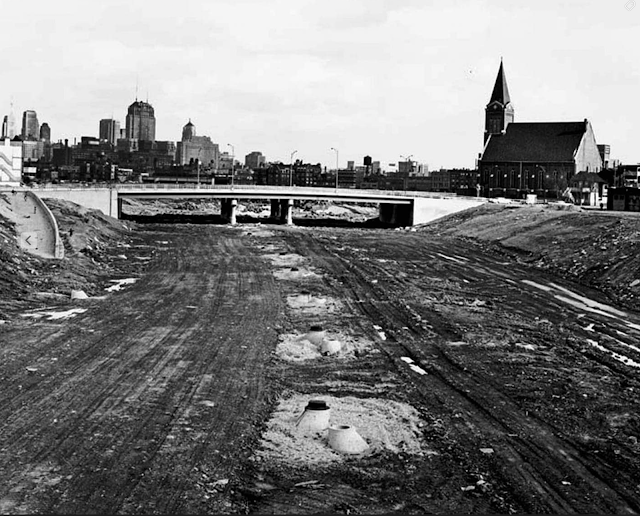
This is the underside of the "Spaghetti Bowl", a/k/a the Circle Interchange of highway ramps along Congress between Halsted Street and the old Main Post Office:
. . . and this is a just released rendering of the design the Chicago Children's Museum is seeking to clout into Grant Park. (You can see three new renderings released by the museum Monday on Chicago Tribune architectural critic Blair Kamin's The Skyline blog, here.)
Kind of reminds you of an updated version of the covered walkways at the University of Illinois, Chicago campus that ultimately proved so unpopular they were demolished in the 1990's.

What is now a berm housing the current Daley Bicentennial fieldhouse, fully landscaped and gently sloping down from Upper Randolph to the park level, with twin ramps gracefully providing access to the park from both the northeast and northwest corners of the site . . .
becomes, in CCM's dispiriting proposal, a convoluted switchback profusion of ramps.
Undoubtedly, the spin doctors at CCM have taken out their tape measures to be able to claim that their new design has just as much green space as the current configuration, but a quick visual comparison . . .
. . . shows that the footprint of CCM's latest design (bottom) cuts a much larger swatch through the park. Just as importantly, much of the surviving green space is sliced and diced into thin, useless strips, isolated islands, and cul de sac dead ends.

You begin to understand why the museum has, until recently, assiduously withheld renderings of their design. Each new drawing, intended to show how the project is responding to critics and getting better and better, only winds up making the thing look worse and worse.

On Monday, the museum trotted out another manufactured committee, this time of educators, in support of their proposals. It appears that Board of Education employees were given paid time off to appear at the press conference.

In contrast to the ad hoc astroturf groups that will disappear the moment the Children's Museum issue is resolved, the list of the real, standing organizations opposing the Museum - those with ongoing memberships, boards, and long, distinguished histories - grew again on Monday, adding the voice of the Metropolitan Planning Council:
We deserve better than being presented with the proposal to relocate the Chicago Children's Museum to Grant Park as a fait accompli without the benefit of a thoughtful planning process which would have added clarity and provided answers to many of the issues circling this controversial proposal. In the absence of those answers and a public planning process, we cannot support this plan.
The paragraph came at the end of a letter signed by Lee Mitchell, Chairman of the MPC Board of Governors, and by President Mary Sue Barrett, a former Daley administration official. The Children's Museum proposal goes before the Chicago Plan Commission, this Thursday, May 15th.

Sunday, May 11, 2008

How to Make a Silver LEED Gold, plus the last of the Merchandise Mart Indians

photograph courtesy of our anonymous correspondent . . .
And speaking of political correctness and the Merchandise Mart, here's a photo from The Box House blog showing one of the indian heads that once graced the facade of the center tower.
The blog reports:
There were once fifty six terra cotta American Indian chiefs that circled the center tower of the Mart; they were three and a half feet wide and seven feet tall. Unfortunately, they were all removed and, according to the Merchandise Mart history page, destroyed in 1961 to put up clean-looking and modern concrete plates. We found "Chief" at an estate sale; the woman's father had been involved in the demolition of the terra cotta facade, and managed to save this piece.
Here's a photo from the Merchandise Mart's website architectural history page showing how the chiefs looked in their original location.
The Box House blog features posts on "How two generations of a family are working to make an Evanston two-flat into a home." There's also some great historical stuff, like this post on Theodore Roosevelt's 1903 visit to Evanston.

National Trust Midwest Opposes Children's Museum Grant Park Land Grab


In a May 5th letter sent to Chicago Planning and Development Commissioner Arnold Randall, Royce A Yeater, Midwest Director of the National Trust for Historic Preservation, has come out in opposition to the Chicago Children's Museum campaign to build a new 100,000 square foot home in Grant Park. The letter concludes:

". . . we also know that that principle of open common ground, uncompromised by construction that blocks views of the street walls that enclosed the park and the lakeshore that defines the city, is a fragile concept, easily eroded by just one small building here, and an addition to another there, until it is gone. Construction of another major museum in the park sets another precedent for the loss of ever more valuable historic open space."

"We encourage the City of Chicago to seek another location for the Children's Museum in a city filled with neighborhoods and underutilized buildings that could benefit from the construction of a major attraction, and allow the concept of common ground established by our forbearers for Grant Park to stand in tribune to an idea that is becoming every more precious in an over developed world."

Saturday, May 10, 2008

Molto Muti - Will 69 be the New 64?

Habemus Papam!
After an extended courtship, the Chicago Symphony finally landed a new music director last week in the person of Riccardo Muti, the charismatic Italian conductor, late of the Philadelphia Orchestra and LaScala, who has signed a five year contract that will run through 2015.

Like Julius Caesar, Muti had turned down the New York Philharmonic's entreaties to lead them, but just twice. The third time it was the CSO's turn. After a series of concerts with the orchestra warmly received by players, audiences and critics alike, Muti, who had professed to be happy to finally be free of permanent appointments, found that the CSO President Deborah Card made him an offer he couldn't refuse.

"It was not what I was expecting," Muti told Sun-Times music critic Andrew Patner, "but it is what I am excited about . . . I want both to devote myself to making music with the Chicago Symphony and to bringing music to the many communities of Chicago and to new generations. This is our future.” This sets him apart from Daniel Barenboim, who fled Chicago at least partially because he chafed under the non-musical duties required of an American music director. Muti tells the Tribune's John von Rhein, "I believe an orchestra exists for everybody in the community, not just for the people who can afford to give money and buy tickets."

Local media coverage of Muti's appointment can only be called ecstatic. All the bad raps on Muti - arrogance, lack of interest in contemporary music, too much hair - are refuted. It's reported that all the CSO, Barenboimites and anti-Barenboimites alike, are reconciled in their enthusiasm for Muti. You're almost led to believe that the conductor's first stop upon his return to Chicago will be Oak Street Beach, to walk on the water. Are we in for an infatuation, or an enduring romance?

Still, if you listen to Patner's extended 2007 interview with Muti, you get a picture of a supremely knowledgeable and still intellectually inquisitive musician who is approachable, eloquent and charming. (At one point he speculates with Patner about a potentional "festival of nuns", featuring works from Poulenc to Prokofiev.)

And just when you're turned off by Muti's supposed antipathy to contemporary composers, you find out, via von Rhein's Sunday story, he's conducted not only Ligeti (festival, anyone?) but the work of Ralph Shapey, and not in Chicago, but in Philadelphia.

In some ways, Muti's programming tastes seem to be a throwback to an earlier age, but that's not necessarily a bad thing. I still have an allergy to Respighi - a recent Muti programming choice here - but a March, 1975 Muti program with the CSO ranged from the Four Sea Interludes from Britten's Peter Grimes, to Stravinsky's Scherzo Fantastique, to Tchaikovsky's First Symphony. The one time I heard Muti conduct the Philadelphia Orchestra, at Carnegie Hall in 1984, it was a concert performance of Gluck's Orfeo and Euridice. And how pleasant it is to contemplate a performance of the C minor Requiem of Muti's beloved Cherubini sung by the CSO Chorus. It's not known whether he's ever programmed Bear Down, Chicago Bears, however.

At age 69 in 2010, Muti will be the oldest person ever to assume the post of CSO music director, five years older than Fritz Reiner when he took the helm in 1953. But while Reiner seemed an old man almost from the beginning. Muti appears, both physically and in spirit, at least a generation younger. And when you consider that over his first five years, Reiner created what remains one of the greatest legacies in classical music, including countless recordings that remain best in class even to this day, well, hope springs eternal.

Thursday, May 08, 2008

Rogers Talks! Piano crosses President! Seducer Stalks Millennium Park!

Hot on the heels of the opening of a smash revival of South Pacific on Broadway, 2007 Pritzker Prize-winning architect Richard Rogers will be coming to Chicago for a May 15th lecture at the Art Institute. Rogers gained fame with the Pompidou Centre in Paris, co-designed with Renzo Piano. His 71-story Three World Trade Center, currently under construction at the WTC site, is expected to achieve Gold LEED status. The lecture begins at 6:00 P.M. Tickets are $5.00 for students, $10.00 for members of the Architecture and Design Society of the Art Institute of Chicago, and $15.00 for the general public. You're urged to go to the A&DS website to make reservations, but I wouldn't recommend it, as the only thing you'll find when you click on "Events" or "News" is the same Microsoft "Server does not exist or access denied" error code that has appeared there for the better part of a year. How such a prestigious organization can allow its web presence to exist month after month in the internet equivalent of leaving your fly open is beyond me.

But I digress. You can also go all retro and call 312.443.3631 to make reservations.

This weekend, if you're patient and can stay awake long enough, you may get to see a key section of Renzo Piano's Nichols Bridgeway being put in place above Monroe Street. The street will be closed from 6:00 P.M. Friday through 5:00 A.M. Monday for both cars and pedestrians.

If you're planning to camp out, a good way to start your evening is to check out Chicago Opera Theater's sexy, well-reviewed production of Mozart's Don Giovanni, which will be simulcast live Friday evening, May 9th from the Harris Theater to a giant 18' x 32' foot screen above the Pritzker Pavilion stage. There's only room for 11,000 people, so get there early. Curtain rises at 7:30 P.M.

Elsewhere in news shorts:

Environmental activist Wendy Abrams, founder and president of Cool Globes, will be honored at an Honorary Diploma at Archeworks' 2008 Graduation ceremony this Sunday, May 11th. More information here.

ULI Chicago's breakfast program, The Credit Crunch - Nine Months Later: When Will it End and How is it Impacting Commercial Real Estate? has a new location at the Grand Ballroom of the Renaissance Chicago Hotel. More information here.

Wednesday, May 07, 2008

Buy Our Museum or (and?) We'll Bury This Child

When you listen to Mayor Richard M. Daley's increasingly desperate attempts to vilify opponents of his effort to force the Chicago Children's Museum into Grant Park, you hear the voice of the suave European exile who appears at the beginning of the film Casablanca, cautioning a middle-aged tourist . . .
I beg of you, Monsieur, watch yourself. Be on guard. This place is full of vultures, vultures everywhere, everywhere.
As he delivers this warning and departs, the suave European places a friendly hand on the shoulder of the tourist, who will soon discover that his wallet is missing.

Similarly, on Monday Daley was telling reporters the museum was going to be built in an underground parking garage because "the community didn’t want to see the children. " He knows, of course, this is a shameless lie. He knows that from the very beginning, the museum proposed building their new structure below ground as part of a calculated effort to evade and subvert the A. Montgomery Ward rulings that have protected Grant Park for over a century. But what's to be gained from honesty, when an angry rant guarantees prime placement on the evening news?

This is the same Mayor that tried to smear those wanting to protect Grant Park as racists. It didn't stick. He tried to portray them as child-haters. People laughed.

He said the only reason 42nd ward alderman Brendan Reilly opposed the museum was that he didn't have children. Anyone with children, the mayor said in an avuncular tone, knows the museum can't be built anywhere other than Grant Park. And when a coalition of opponents stepped forward to say no, as fathers and mothers of small children they, too, didn't want Gigi Pritzker's pet project in Grant Park, the Mayor seemed to be suggesting that their children would grow up to hate them. As quoted in the Sun-Times, he said of the museum opponents, "They'll go start petition drives. They're threatening everybody — your political life. They're gonna defeat all aldermen. They're gonna beat everybody in the world. But, one thing. Those children grow up and remember them," the mayor said.

And, of course, the Mayor said this knowing that his administration, from the start, has been strong-arming alderman to keep them in the pro-museum fold, pressuring them to commit political suicide by voting to override the long-standing principle of supporting each other's veto's of projects within their ward boundaries, a bedrock source of their power that the Mayor seeks to dilute and consolidate into his own hands.

Power isn't pretty, and you'll find no better portrait of it than in Al Podgorski's page 18 photo in Tuesday's (May 6th) Chicago Sun-Times. Understand, everyone can take a bad picture - I'm proof of that. But Podgorski's portrait of the Mayor isn't a gotcha moment; it's a remarkable Picture of Dorian Gray-like reveal of the mayor, his face contorted into a snarl, a sneering mask of contempt towards anyone who would dare to dissent from his judgment. This is the face that strikes terror into the hearts of alderman, commissioners and staff. This is the face that says, I own this city - get on board or you're less than nothing. (You have to pick up a hard copy of Tuesday's Sun-Times; the web version of the story uses a more conventional photo.)

Museum proponents, taking their cue from the mayor, have become firm adherents to the idea that any statement, however ludicrous, can be put over if you just say it with deadpan conviction. Children's Museum President Jennifer Farrington apparently believes she can make 100,000 square feet of construction disappear by telling ABC7, "We are not talking about bringing a new building, we are talking about a new resource to the park." Or, as Jimmy Durante once said, "What elephant?"

At a Tuesday morning debate with Alderman Reilly at the Union League Club, as reported by Medill Reports, Farrington again said that the Grant Park site was the only place for her museum. “No other location met our four requirements: A central downtown location, easy access to public transportation from all corners of the city, access to green space, and plentiful adjacent covered parking.” I can think of a lot of places that meet the first three requirements - I'll talk about my own choice later this week, but the fourth - covered parking - is simply bizarre. The Field Museum - no covered parking. Adler Planetarium, Shedd Aquarium - no covered parking. Altogether, they attract millions of parents and children each year. Do all those children somehow become enfeebled mutants when they visit the CCM? At Grant Park, won't many, if not most, disembark from buses on covered lower Randolph? No matter. Devise your clout-empowered whims in haste, come up with rationalizations at leisure.


Last week, the museum issued still another revision of its design, which again claims to reduce the structure's presence in the park. It doesn't really. The high sculptural skylights of the previous proposal aren't really gone; they're just stuffed underneath a maze-like series of ramps and terraces stepping down from Upper Randolph. As you can see in the rendering below, the glass is still several times human height. A landscaped terrace off of Upper Randolph would become a narrow strip leading to the ramp entrance. Current ramps leading down to the park from Upper Randolph in both the east and west corners of the site would be replaced with a single entrance. The easternmost ramp is eliminated entirely. In the latest design, you can see the shadow of still another structure just north of the current tennis courts nearest Columbus Drive. To get from Upper Randolph down to the park, you have to keep doubling-back on ramp segments that are almost all about a half a block or more long. The museum's Randolph Street entrance has been cut in size by 3/4, and moved off the site and onto the sidewalk, the better to evade the A. Montgomery Ward protections. The latest revision is less a design than a legal stratagem.

Check it out for yourself. Chicago Tribune architecture critic Blair Kamin has posted six drawings here.

Tuesday, May 06, 2008

Hearing of its Impending Ban, a Plastic Bag takes Flight, plots Escape


Monday, May 05, 2008

News You Can Use

Sunday, May 04, 2008

Renzo Piano Art Institute Bridge Begins to Take Flight

Courtesy of Bob Johnson, we offer you these photos of the current state of the work on the Nichols Bridgeway, the Renzo Piano designed, 615-long incline designed to suck visitors from Millennium Park up into the Art Institute of Chicago's new Modern Wing, scheduled to open, along with the bridge, early next year. Piano may have missed a prime opportunity. Judging from these pictures, his structure, bent to the west, would have made a great water slide, depositing delighted passengers directly on the shallow sea of Jaume Plensa's Crown Fountain.

We'll have a photoessay with lots of our own pictures of both the Modern Wing and the Nichols Bridgeway soon, but for now here's a couple of samples.

Saturday, May 03, 2008

UIC's At the Edge adds Architects to the mix for 2009 Innovative Art in Chicago Series

For the first time this year, Gallery 400 at the University of Illinois at Chicago is adding architecture, design and new media to their at the edge: innovative art in chicago program, an annual series of commissioned projects that began with gallery installations, public performance, websites, and more. May 31st at 6:00 P.M. (postmark or drop-off time) is the deadline this time out. According to the competition flyer:
Inquiry, experimentation and ingenuity are the basis of At the Edge. As Chicago’s artistic, architectural and design scene continues to be an expansive, resourceful and energetic creative arena, Gallery 400 at the University of Illinois at Chicago encourages the most innovative aspects of that dynamism. We are looking to work with individuals ready to take a conceptual, political, speculative or aesthetic risk. Propose a project you might not be able to realize elsewhere, one you never thought could get made. . . . Four individuals or group collaborations will be chosen to present projects lasting from one night to two months (possibly longer for public projects; gallery exhibitions typically last six weeks) that will be supported by Gallery 400’s professional resources, an honorarium and a moderate production budget.
Combined honorariums/production budgets range from $500 to $6,000. Finalists will be chosen by a jury of artists, architects, designers, curators and art administrators. An "executive group" of that jury, headed by Gallery 400's director, will make studio visits and conduct interviews to arrive at the four winners, who will be notified in late June, with the actual mounting of the projects scheduled from January to October of next year.

You have to be from the Chicago region to be eligible, but you can't be current UIC faculty or staff, or a student enrolled in classes this summer or fall. More information, including application forms and complete rules, can be found here.

Friday, May 02, 2008

Looptopia, Great Chicago Places, Goldberger, Dongtan and Darwin - It's the May Calendar of Architectural Events

OK, there better not be any complaints now. What with Friday's allnighter Looptopia scattering theatre, music, art and spectacle all throughout the Loop, and this year's Great Chicago Places and Spaces in mid-month, there are literally hundreds of architectural events to choose from this May. Paul Golberger. Lee Bey. Leon Depres. Anthony Alofsin (Saturday night at Unity Temple). David Bahlman. Pearl River Tower. Asymptote's Lise Anne Couture. Design in the Age of Darwinism. Archeworks annual gala. The History of 'L'. The history of the Parking Garage. Restoring the world's largest Tiffany Dome. Garfield Park Conservatory. Presentations for SEOIA's excellence in engineering award. Cher. You get the idea. And there's lot more. Check it all out here.

Thursday, May 01, 2008

Fish Liberation Army Strikes Today at Noon

I'm still putting the finishing touches on the May calendar. Posting Friday, I hope.

In the interim, here's an interesting event for today, Thursday, May 1st. Friends of the Chicago River will celebrate this season's opening of the McCormick Tribune Bridgehouse and Chicago River Museum by releasing 200 baby bluegills into the Chicago River at noon. For just 5 bucks, you can actually adopt a baby bluegill, name it and release it. Just don't expect any thank you letters. (Fish can't write, and if they can't find a job upstream, be prepared they may come back to live with you for a while . . . just until things work themselves out.)

The Museum will also keep its doors open afterhours this Friday evening, as part of the second Looptopia extravaganza, which will offer 14 hours of programing - music, theater, art and spectacle - into the wee hours of Saturday.

And here, courtesy of Bob Johnson, is a photo of the actual event, as a bluegill wins its freedom.

I've Been Tagged - And We All Know How Painful That Can Be

Andrew Patner tagged me.

I never respond to chain letters, both because I don't want to encourage them and because I've been much too busy corresponding with Madame DeNuovo, who has $50,000,000 she needs my help getting out of her native country.

However, when you're "tagged", as I have just have been by cultural critic and blogger Andrew Patner, I can't really decline. I'm just upholding the law. It's a federal law, actually.

So here, apparently, are the rules:

1. Pick up the nearest book.
2. Open to page 123.
3. Find the fifth sentence.
4. Post the next three sentences.
5. Tag five people, and acknowledge who tagged you.

OK:

1. The nearest book is one I've been meaning to finish for the past fifteen years. (I'm basically illiterate, and this book has no pictures.)
2. I found page 123 by locating pages 122 and 124 and rummaging about in between them.
3. Here's carrots for lunch
At tuppence a bunch.
(I think that's one sentence; the author's style of punctuation veers toward the idiosyncratic)
4. "Oh!" exclaimed Albertine, "cabbages, carrots, oranges. All the things I want to eat. Do make Françoise go out and buy some.
5. Unfortunately, AP has already taken my own most likely choices, and since I lead a hermetic existence that generally shuns contact with other human beings, I have to stretch a bit to come up with:
a. John Hill, who left Chicago for the corrupt Eastern seaboard and has seen his blog's readership numbers soar ever since, damn him.
b. Blair Kamin, because he has a Pulitzer and I can't even get a prize when I buy a box of Cracker Jack.
c. Toronto's Terry Murray, because I've already quoted Bill Murray elsewhere in this post, and because she has a great blog tracking down interesting gargoyles.
d. Donald Trump, because he was just in Chicago to dedicate his new Trump Tower, and never stopped by to say, "Hi!"
e. Mark Cuban, because he's probably going to buy the Chicago Cubs and because I believe that, now that Fidel is gone, we should all try to get along better with the Cubans.

OK, can I go to bed now?

Wednesday, April 30, 2008

Impressionists: the End is Near! (For Now)


Chai Lee of the Art Institute recently sent us an email reminding us that this is the last week to view the museum's incomparable collection of Impressionist masterworks in the setting to which we've grown accustomed to seeing them for the past thirty years. After this Sunday, May 4th, a more benign local version of Colonel von Waldheim will be crating up all the canvasses and shipping them to Texas, where they'll be on display in the Kimball Museum's blockbuster exhibition, The Impressionists: Master Paintings From the Art Institute of Chicago, which will run from June 29th through November 2nd. A few old favorites, such as Seurat's La Grande Jette and Cezanne's Chiens Jouer au Poker will continue to hold down the fort awaiting their companions' return.

Other gallery renovations are already nearing completion. Some time in June, we'll see the new galleries for the museum's Department of Prints and Drawings, designed by wHY's Kulapat Yantrasast. (Check out the strange animation, which depicts what must be an architect's wet dream: perfect, white-walled galleries almost entirely unsullied by actual art.) Then in July, Renzo Piano's revamp of Gunsaulus Hall, aka "the bridge to the other side", is scheduled to be unveiled. Windows along the north side which had been bricked over since the 1930's will once again bring natural light into the galleries and provide "stunning views of Millennium Park", and of the urban theater of the Metra trainings passing below.

The AIC promises that all our old friends will be home for Christmas, - December 22nd, to be exact - but stop in by Sunday to wish them a bon voyage for their excursion into the realm of Louis Kahn.

Tuesday, April 29, 2008

The Wrigley Company is Dead! Long Live the Wrigley Building!

Contrasting local presences: Left, Global Headquarters, William Wrigley Jr. Company, Michigan Avenue; Right, Metra Station serving Mars candy plant, west side of Chicago [Metra photo]
It may shock some people to learn that the 1921 Wrigley Building, arguably one of Chicago's half-dozen most recognizable buildings, has never been afforded official landmark protection. The argument has always been made that the Wrigley family, throughout the decades, has been a responsible steward for a structure that, like Marina City, has become a symbol for Chicago throughout the world.

And they have. Just as, for over a century, the William Wrigley Jr. Company has been a bedrock component of Chicago's economy and culture. But in today's hyper-volatile, hyper-scaled, aggressively globalized world, all that can change in a snap of the fingers.

And it just did. Only six years ago, in a failed attempt to acquire much larger Hershey Foods, Wrigley muffed its chance to be the fish that swallows, and on Monday became the fish that gets inhaled, agreeing to be acquired for $23 billion by Mars Inc.

As always in these things, all parties are insisting nothing much will change. Wrigley will retain a major autonomy in its operations and a strong Chicago presence. And that may be true. Less than three years ago, the company opened it news $45,000,000 Global Innovation Center on Goose Island, designed by Hellmuth, Obata and Kassabaum. Yet the lesson of corporate history is that companies seldom pay $23 billion for an asset without succumbing to the itch to tinker and streamline in search for the best possible return on its sizable investment.

So, while continuing to ascribe to Wrigley/Mars nothing but the best of intentions, the time has come to ask for a small token of good faith.

Even though, as a private company, Mars is insulated from the stock market's ruthless appetite for uninterrupted good news not just quarter to quarter by seemingly moment by moment, no corporation is immune to an economic ethos in which a beloved building, considered a prime asset for nearly ninety years, can devolve, almost overnight, into a redundant white elephant, suitable only for cashing out the value and purging it from the books.

The time to begin the landmarking process is now.

Sunday, April 27, 2008

Four from Artropolis 2008

Artropolis is on the scale of the kind of things Chicago used to do just to prove it could. The art show, which closes on Monday, takes up more than half a million square feet in the gigantic Merchandise Mart, and includes thousands of works from thousands of artists from all over globe, in no fewer than five different shows, from insider artists, to outsiders, to the undiscovered, and the antique. You could camp out at the Mart for every one of the 28 hours the show is open and still not do it justice. (But you wouldn't starve - there's a wide selection of often high-end food and drink.)

There were a large number of works that grabbed my attention, but I'll concentrate on just four with an architecture tie-in that caught my eye.

The Robert Koch Gallery is exhibiting the work of photographer Michael Wolf, whose work on exhibition at Artropolis includes the hyper-realist shot, shown above, of Marina City, which contrasts the rigid form of Bertrand Goldberg's towers with the intimations of humanity - visible clearly in the supersharp photo, reproduced in large scale - within the lighted units.

The Linda Durham Gallery of Contemporary Art of Santa Fe includes this photograph by Michael Eastman. Titled Fidel's Stairway, it's part of a series depicting architecture in Cuba. In contrasting one of dictator's proclamations with the decaying grandeur of the colonial-era staircase on whose wall it is inscribed, the photo manages to combine history, reportage, architecture and poetry all in one shot. Eastman's own website offers up a very generous gallery of his strikingly evocative work capturing architecture, from the monumental to the mundane, from both the U.S. and across the world.

The Priska C. Juschka Fine Art Gallery in New York City's Chelsea district is showing the work of Dana Melamed, the Israeli born artist, now living in New Jersey, who creates dense, three-dimensional surfaces "by dipping printing waste and film into acrylic and glue, torching and melting them, then drawing and scratching into the layers with a razor." Melamed says the destructive techniques reflect urban life, and especially on a day when I'm slightly overwhelmed by it, I'm not one to argue. The portfolio of her work, which you can sample here, has a hypnotic Piranesi-like complexity that reads city life through its decay and destruction. The detail shown here is from a 2007 work titled, When The Sky Turned Grey. What shows up here as flat is actually an intricately layered assemblage of materials. You can see a sequence of photographs of Melamed at work here.

Finally, at the Next show section of Artropolis (at the south end, right next to the food), Galerie Vernon is showing the mesmerizing work of Jakub Nepraš, a Czech artist who makes boldly colored, fantastical videos, such as his Babylon Plant, in which corpuscles that are actually - if I understand it correctly, moving vehicles and people - pulsate throughout the arteries of large, amorphous organisms.

Atropolis is open on Sunday from 11 A.M. to 6 P.M. If you can find a way to play hooky from the office on Monday, April 28th, it's open from 11:00 A.M. to 4:00 P.M. (3:00 P.M. for The Merchandise Mart International Antiques Fair, The Artist Project and the Intuit Show of Outsider and Folk Art.)

Sally Kitt Chappell reads from Chicago's Urban Nature (twice) on Wednesday

In what will undoubtedly be the last late listing to the April calendar of architectural events, author Sally Kitt Chappell will read from her book, Chicago’s Urban Nature: A Guide to the City’s Architecture and Landscape, twice, this coming Wednesday, April 30th. The first event will be at 12:00 P.M. in the Millennium Room of the Chicago Cultural Center, the second at Access Living's award-winning new headquarters at 115 West Chicago, designed by LCM Architects.

Chappell's book provides an "illustrated guide to Chicago's stunning blend of nature and architecture. At the heart of the city's urban concept is the idea of connection, bringing buildings and landscapes, culture and nature, commerce and leisure into an energetic harmony. Packed with maps and recommended tours, and bursting with splendid photos, this is an essential guidebook for day-trippers, lifelong Chicago residents, and professionals in landscape architecture, urbanism, and design."

The lecture is the third in a series of Five Weeks of Conversations Within Communities, a series sponsored by the University of Chicago Press and Chicago's Mayor's Office of Special Events that has as its goal "fostering dialogue between Chicago citizens and Chicago writers. The series continues with a May 7th lecture by Louise W. Knight, author of Citizen: Jane Addams and the Struggle for Democracy, and concludes on May 14th with Stuart Dybek, author of Childhood and Other Neighborhoods, as a final lead up to Chicago's annual Great Chicago Places and Spaces, which will be offering up over 200 tours May 17th and 18th.

Thursday, April 24, 2008

Staggered Truss: Not as Painful as it Sounds

A new hotel brings an innovative engineering technique, pioneered by the American Institute of Steel Construction, to Chicago for the first time. Iconic architecture, via Valerio Dewalt Train, to follow. Read all about it, and see how the thing will look when it's finished, and a lot more images. here.

Chicago Streetscene - 343 North Dearborn